A side project becomes a business when it clears three gates in order: revenue that is real and repeating (not launch-spike curiosity), operations that survive your absence for a week, and a runway calculation in which quitting your job doesn't kill the company in month four. Most failed transitions skip a gate — quitting on applause, or scaling effort on a product whose users churn the moment the novelty fades. The playbook is deliberately unromantic: gate by gate, with numbers written down before the leap.
This is a decision guide, not financial advice — quitting a salary has tax, insurance, and immigration implications that deserve professional review.
Gate 1: Is the revenue real?
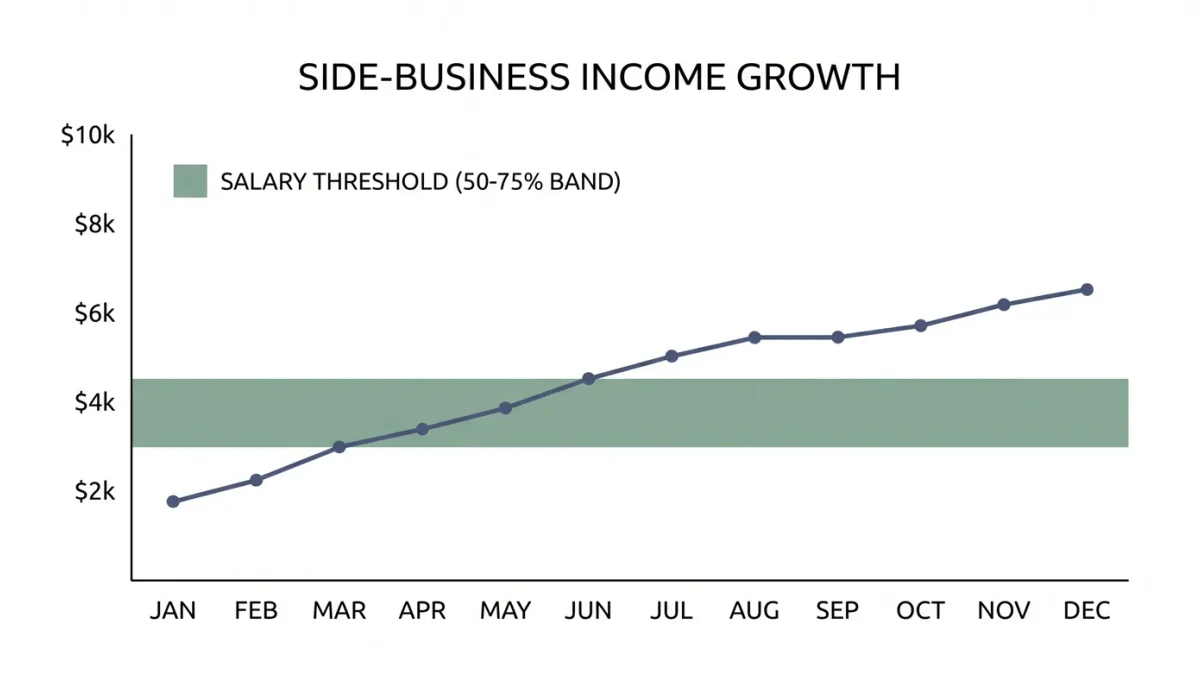
Real revenue is repeat or recurring, from people who found you without knowing you, at a price that resembles a market. Test each: recurring means subscriptions, retainers, or repeat purchase behavior visible over at least three months; strangers means at least a third of revenue from outside your personal network; market price means you've raised the price at least once and volume held. Per Census Bureau nonemployer data, the U.S. counts over 27 million businesses with no employees — a large share of them side businesses that never needed to become more — which reframes the question honestly: the goal isn't to quit for status, it's to quit when the economics force the choice. The practical threshold most operators use before considering the leap: the project consistently earns 50–75% of your salary, because the final 25–50% reliably follows full-time focus, not before.
Gate 2: Can it run without evenings-and-weekends heroics?
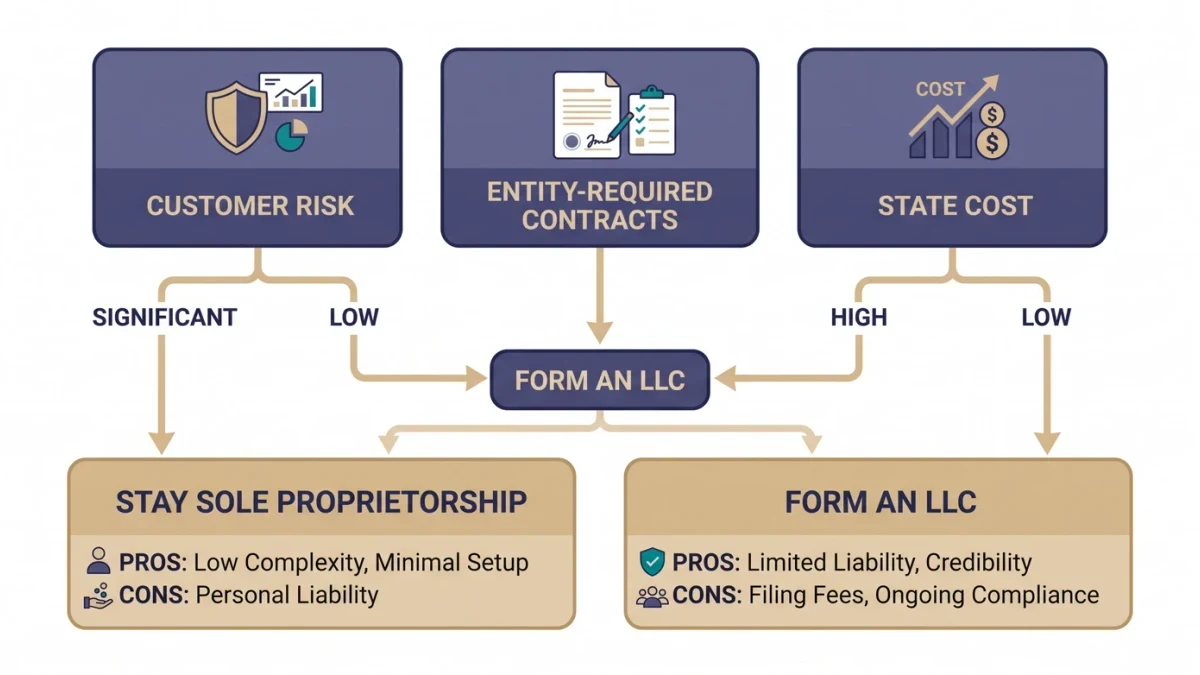
Full-time focus should go to growth, not to propping up operations the side-project mode never built. Before quitting: automate or productize the delivery bottleneck (the thing that consumes your evenings), document the recurring workflows to a page someone else could follow, and take one full week off to see what breaks. What breaks during your absence is the transition's real to-do list. This is also the right moment to separate the project's legal and financial identity — its own entity, bank account, books — because commingled finances are both a diligence problem later and a clarity problem now: you cannot read the project's margins if its costs live in your personal cards.
Gate 3: Does the runway math survive quitting?
Three calculations, written down. Personal: months of living expenses covered by savings plus the project's profit, at your current spending — with the healthcare line item made explicit, since employer insurance is the subsidy most quitters forget to price. Business: the growth plan the freed-up 30+ hours will execute, stated as specific bets — two features, one channel, ten outbound conversations a week — because "more time" without a plan dissipates into more of the same. Combined: the kill-or-commit date, typically 12–18 months out, with the metric that decides it. Per Federal Reserve statements, the policy rate sat at 3.50–3.75% after the December 2025 cut — capital is not free, and self-funding remains the default transition mode; the runway you have is the runway you saved.
How do you actually run the transition?
| Month | Focus | Milestone |
|---|---|---|
| –6 to –3 | Gate 1 evidence, price raises, systems | Revenue ≥ 50% salary, 3-month trend |
| –3 to 0 | Gate 2: automate, document, week off | Nothing critical breaks in absence |
| 0 to 3 | Execute named growth bets | Revenue back to ≥ salary |
| 3 to 12 | Double down on the bet that worked | Commit-or-kill metric on track |
The month-3 milestone — revenue recovering past your salary — is the honest signal the transition worked; the growth bets, not the extra hours, produce it.
What if the gates never clear?
Then the project has told you what it is: a profitable side business, which is a fine thing to own. The failure pattern to avoid is the ambivalent middle — reducing day-job commitment, feeding neither effort properly, and resenting both. A side business run deliberately (capped hours, priced properly, systems maintained) outperforms a half-quit company run on guilt. Revisit the gates annually; revenue that recurs without heroics has a way of answering the question for you.
- Gate 1: real, repeating, stranger-sourced revenue.
- Gate 2: operations that survive a week without you.
- Gate 3: runway math with a written commit-or-kill date.
Clear the gates, write the numbers, then leap — or keep the profitable side and stop apologizing for it.