A bootstrapped business needs a one-page plan that answers four questions with numbers: who pays, what it costs to deliver, what monthly revenue covers your life, and what this quarter's single growth bet is. The 30-page plan written for a banker's template is theater for bootstrappers — nobody funds you to write it, and it's stale in a month. The discipline is the opposite: a page short enough to rewrite monthly, where every line is either a decision or a number you actually track. Per the U.S. Small Business Administration's planning guidance, the value of any business plan comes from using it as a living decision document — which for a self-funded company means as small as honesty allows.
This is a planning guide, not financial or legal advice; entity and tax choices belong with professionals.
What are the four questions?
Who pays, and for what? — your offer in the buyer's words: segment, outcome, price. What does delivery actually cost? — your fully loaded cost per unit of sale, including the software subscriptions you forget to count. What's the survival number? — monthly revenue that covers business costs plus your minimum personal draw, the figure that defines "working." What's this quarter's one bet? — the single experiment that, if it works, changes the trajectory: a channel, a price change, a productized offer. One bet, not five — bootstrappers die of diluted focus with the same reliability as startups.
Why does the survival number anchor everything?
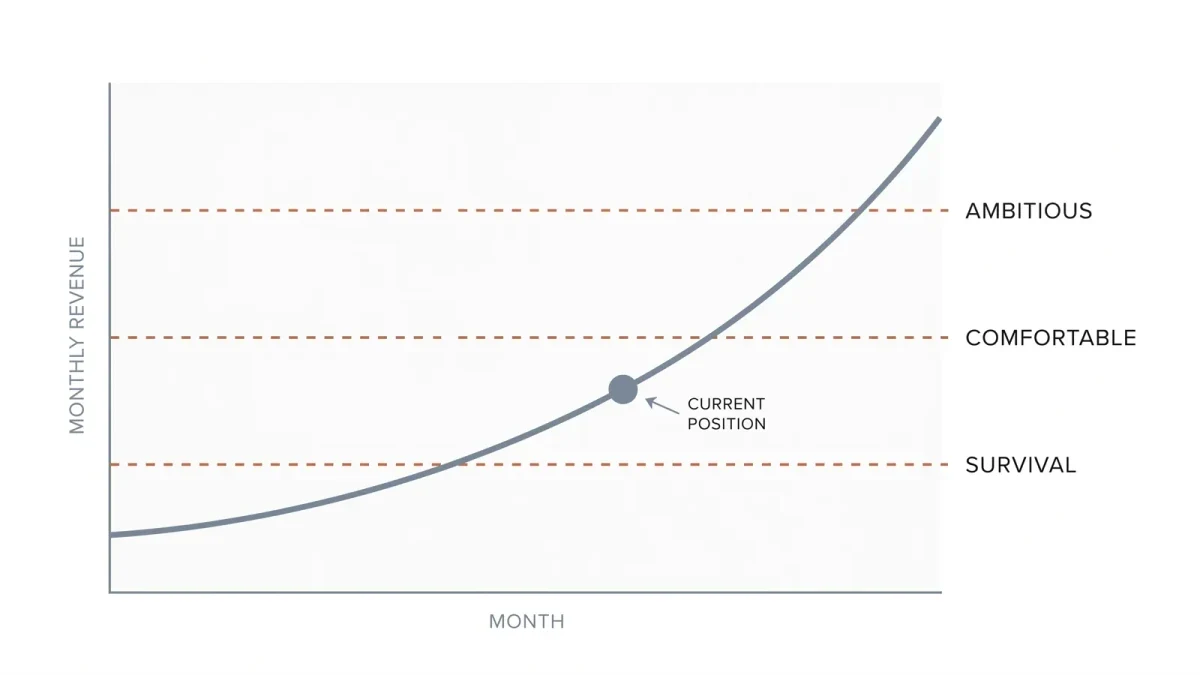
Because bootstrapped strategy is the management of the distance between current revenue and the survival line. Above it, every dollar is a growth decision; below it, every day is a cash decision, and growth bets are a luxury the arithmetic forbids. Write three versions of the number: bare survival (business costs plus true minimum personal), comfortable (your actual salary needs), and ambitious (funds the next hire). Each version defines a different game — and knowing which one you're playing this quarter prevents the classic bootstrapper error of making ambitious-game decisions (hires, office, brand spend) from bare-survival positions. Per Federal Reserve statements, the policy rate ended 2025 at 3.50–3.75% after the December cut — borrowed working capital is available but not cheap, which keeps self-funding and customer-funded growth the bootstrapper's default instruments.
What goes on the actual page?
| Section | Content | Rewritten |
|---|---|---|
| Offer | Segment, outcome, price — one sentence each | Quarterly |
| Three numbers | Survival, comfortable, ambitious revenue lines | On any cost change |
| Unit economics | Revenue per sale, cost per sale, hours per sale | Monthly |
| This quarter's bet | The one experiment, with a success metric and end date | Quarterly |
| Not-doing list | Opportunities declined and why | Continuously |
The unit-economics row does the most work: hours per sale is the bootstrapper's scarcest currency, and a business whose revenue grows while hours-per-sale stays flat is a job with extra steps. Productizing — converting custom work into repeatable packages — is how that number falls, and it's usually the winning bet before any marketing bet.
How does the page get used monthly?
The monthly review is 45 minutes, calendar-protected: actual revenue against the three numbers, hours-per-sale trend, the bet's metric versus its target. Three outcomes, three responses — bet working: double it and write next quarter's version; bet failing at its metric: kill it, note the lesson on the not-doing list; bet ambiguous: extend once, never twice. The page's history becomes your best management document: twelve monthly versions read in sequence show whether the business is compounding or just oscillating, and the answer is frequently humbler than the feeling of busyness suggests.
When does the one-pager grow up?
Two triggers: a bank or a partner demands a conventional plan — write it from the page, which takes an afternoon instead of a month because every number already exists — or the business hires, at which point the page sprouts a second sheet: who does what, at what cost, reporting to the survival numbers. What it never needs is a vision statement section; in a bootstrapped company the vision is legible from twelve months of the page — what you bet on, what you declined, what you protected. Keep the page honest and small, rewrite it monthly, and let the business grow into the documents it actually earns.