Your first hire should remove the bottleneck you can point at in your own calendar — most often delivery (so you can sell more) or administration (so you can both build and sell), and almost never another strategist to share the thinking. The founder's calendar is the diagnostic: track two weeks in 30-minute blocks, and the role reveals itself where the founder's highest-value hours are being consumed by work someone else could do. The first hire is also the company's first system, because what you document to train them becomes the operating manual everything later runs on.
Employment brings legal obligations — classification, payroll, benefits — this is an operations guide, not legal advice.
Which role comes first?
For service businesses, the canonical answer is a delivery-capable hire who takes execution off the founder, freeing sales hours — the revenue math usually pencils because founder sales time is the company's scarcest and most valuable resource. For product startups pre-revenue, it's the person who ships the thing users feel (engineer) or the one who unblocks the founder from support and operations. The universal second-place candidate is an executive assistant or operations generalist — cheap relative to founder hours, and a forcing function for documenting the chaos. The universal wrong answers: a "co-founder-lite" strategist with no defined function, a salesperson before the founder has a repeatable script (early sales must be founder-led to be learnable), and anyone hired because the calendar said "CEO" and status said "need a team."
How do you know you're ready?
Three readiness tests. The work test: at least 25–30 hours a week of the role's work exists consistently — a job built from scraps dissolves in month two. The cash test: the hire's fully loaded cost (salary × 1.25–1.35, per employer cost data from the U.S. Bureau of Labor Statistics) fits within a runway that stays above your safety threshold, or the hire directly unlocks the revenue that pays for them. The systems test: you can describe the first month's work in a one-page plan, because "we'll figure it out together" describes a co-founder, not an employee. Fail the work or systems test and the fix is documentation or waiting — not a bigger talent pool.
Contractor or employee?
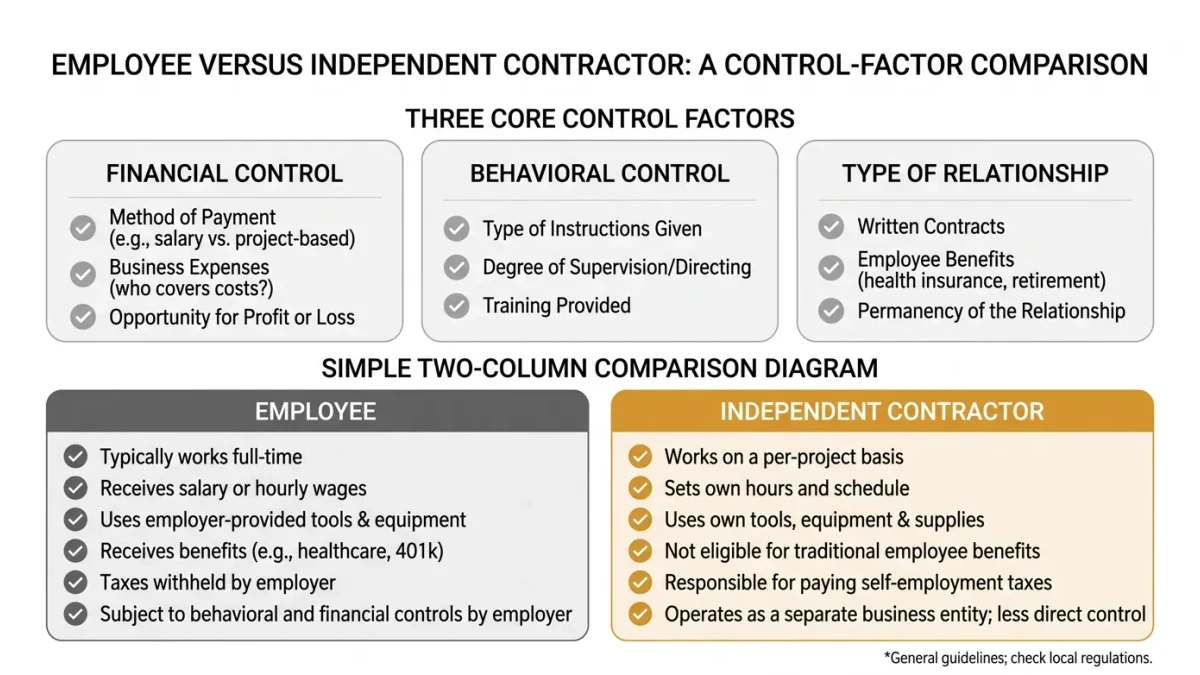
Contractors suit project-shaped, episodic work and test relationships before commitments; employees suit the continuous core. Misclassification is a real legal risk with real penalties, and the tests are about behavioral and financial control — when the work is your core, directed by you, on your schedule, the law generally sees an employee regardless of the label. When in doubt, an employer-of-record service converts the question into a line item. The bootstrapper's pragmatic sequence many follow: contractor first for the defined project, employee conversion when the work proves continuous — deliberate, legal, and cheaper than either mistake.
What does onboarding look like for company of two?
| Week | Focus | Founder's job |
|---|---|---|
| Pre-start | One-page role plan, tools, access | Everything ready day one — nothing says "disorganized" like a stalled first week |
| 1–2 | Shadow and document | Do the work together once; they document the process as you go |
| 3–4 | Own with review | They run, you review outputs before they ship |
| 5–12 | Own solo, weekly check-in | Step back; resist re-doing their work at midnight |
The documentation produced in weeks one and two — the process doc, the quality checklist, the "how we do things" page — outlasts this hire and becomes the training asset for hires two through ten. That's why the first hire is a systems event, not just a staffing one.
What are the classic first-hire failures?
- Hiring a mirror: another big-picture generalist; now two people avoid the same tasks.
- The unpriced trial: no 90-day checkpoint with written criteria, converting a misfit into a slow, guilt-laden exit.
- Delegation abdication: handing off outcomes with no review loop until quality diverges for months — then repossessing everything in a panic that teaches them learned helplessness.
- Overpaying in title: "VP of Operations" for an ops-generalist role boxes in the real executive hire you'll need at thirty people.
Each failure traces to skipping the diagnostic: the calendar data, the readiness tests, the one-page plan. Hire for the named bottleneck, document as you train, review weekly, and make the 90-day decision deliberately. Then notice what your calendar looks like in month three — that answer tells you who hire number two is.