A SAFE (Simple Agreement for Future Equity) is a promise to take investment money today and settle the shares later, at whatever price your next priced round sets, subject to a cap and a discount you negotiate now. A priced round — usually a preferred equity sale led by a venture firm — prices every share today, adds a stack of legal terms, and takes weeks longer to close. The SAFE's virtue is speed and simplicity; its cost is that ownership stays ambiguous until conversion. Choose a SAFE when you need money fast and the round is small; choose a priced round when the amount is large, a lead investor wants board terms, or your cap table needs to be legible for a major hire or an acquisition conversation.
What happens to a SAFE when the next round closes?
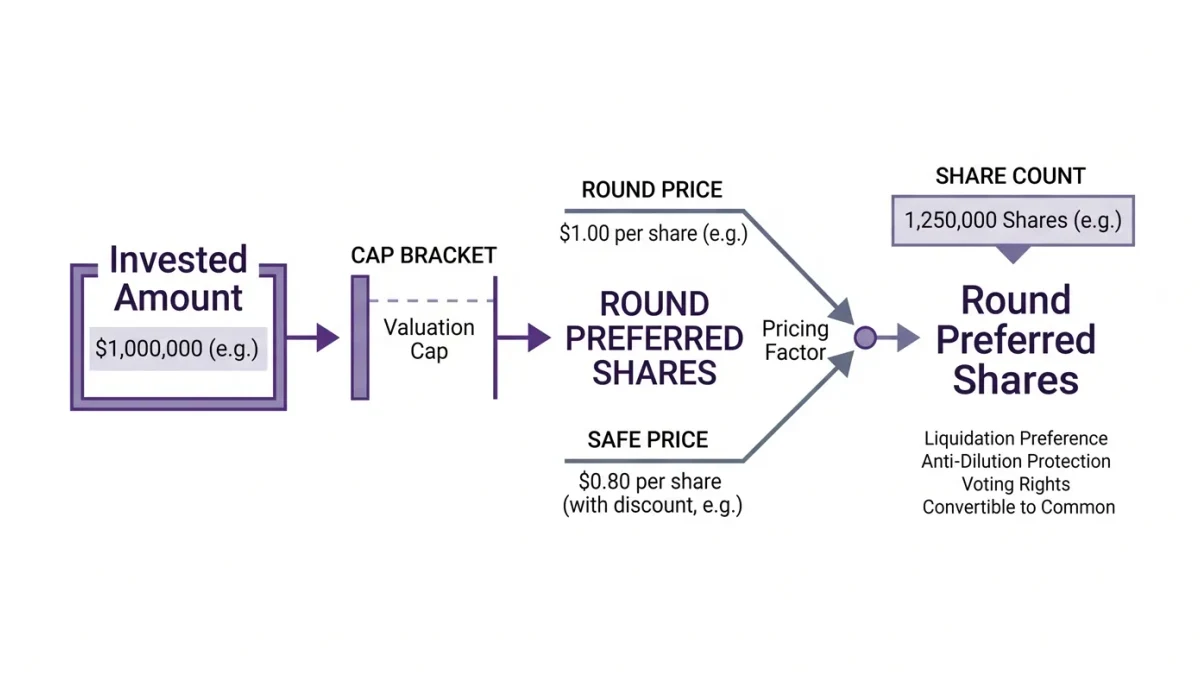
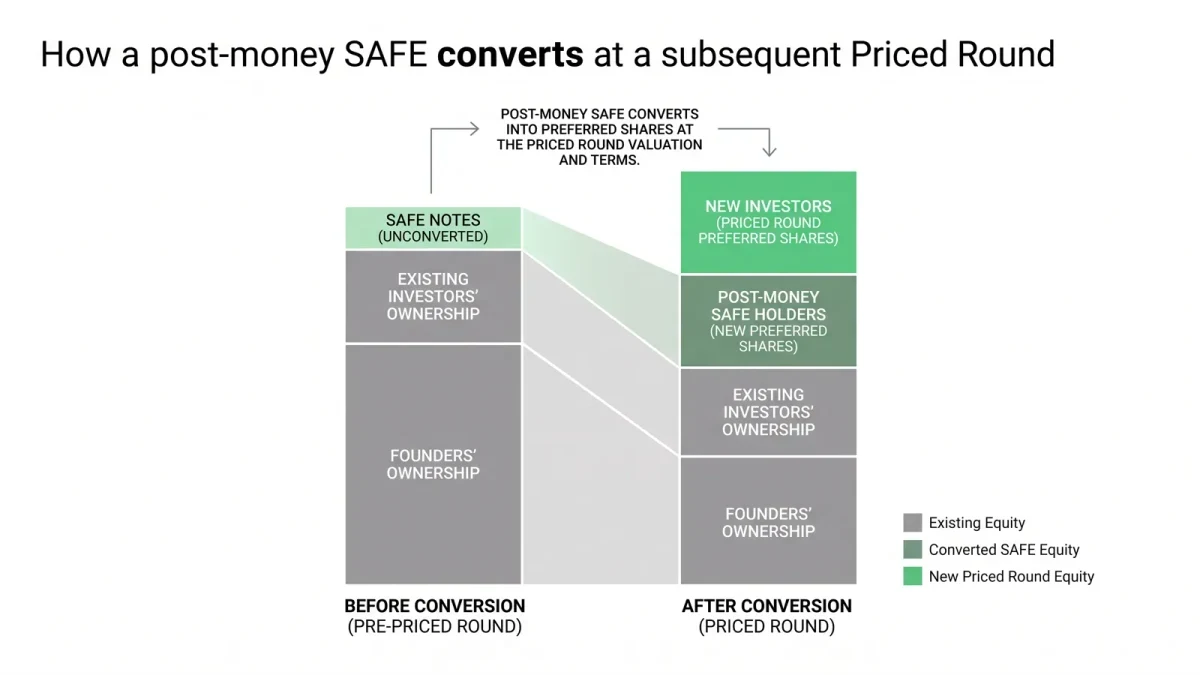
At the priced round, each SAFE converts into preferred stock at the better of two prices: the valuation cap divided by the round's valuation, or the round price less the discount — typically 10–20%. Concretely, if you raised $500,000 on a $10 million post-money cap and the next round prices the company at $20 million, the SAFE investor's money converts as though the company were worth $10 million, so they receive roughly twice the shares per dollar than the new money gets, minus the discount arithmetic. Post-money SAFEs make this math legible going in: with a post-money cap you can compute today what percentage the investor will own at conversion, as Y Combinator's standard documents set out. Pre-money SAFEs shift some of the ambiguity back onto the founder, which is why the post-money form became the default.
What does a priced round bind you to?
Three things a SAFE does not. First, price: preferred shares are issued at a fixed per-share value, so ownership is settled and everyone can compute their exact stake. Second, governance: the lead negotiates a board seat, protective provisions, and approval rights over future raises, sales, and sometimes budgets. Third, information rights and pro-rata commitments that run for the life of the company. The payoff is that large sums move — institutional leads will not write an $8 million check on a SAFE — and the cap table becomes legible to everyone from lenders to acquirers. The cost is four to eight weeks of diligence and legal work, and tens of thousands of dollars in fees that come out of the company.
When does a SAFE hurt you?
When SAFEs stack. Each uncapped-friendly instrument converts at the next priced round, and if you have raised, say, $2 million across multiple SAFEs against a company that prices at $8 million pre, the founders can discover that conversion plus the new money's stake consumed more of the round than planned — the arithmetic that makes a round feel "expensive" even at a headline valuation you like. Two habits prevent the surprise: model every outstanding SAFE's conversion before signing the next one, and keep total SAFE dollars proportional to the valuation you can credibly defend at the next round. Valuation caps that looked generous at seed can also bracket a down-round conversation in awkward ways.
How do you choose in practice?
Use the decision table below as a starting frame, then pressure-test it with counsel.
| Situation | Better fit | Why |
|---|---|---|
| Raising under ~$1–3M from angels or funds without a lead | SAFE | Speed and low legal cost; terms are standard and negotiable in one page |
| Institutional lead writing a large check, wants a board seat | Priced round | Leads require priced preferred; governance terms come with the money |
| Bridge between rounds inside existing investor group | SAFE or priced, case by case | Post-money SAFE keeps the bridge fast; priced notes fix dilution now |
| Major hire or acquisition talks need a legible cap table | Priced round | Counterparties need settled ownership percentages, not conversion scenarios |
What terms deserve the most attention?
On a SAFE: the cap, the discount, post-money versus pre-money, and — if anyone proposes it — the maturity and valuation-cap interplay of any convertible note variant that adds interest and a repayment obligation. On a priced round: liquidation preference (1x non-participating is the clean norm), the option pool size and whether it comes out of the pre-money, anti-dilution provisions, and board control. Every one of these is negotiable in the sense that you can ask; few are negotiable in the sense that the market moves. Knowing which is which is most of the negotiation.
FAQ
- Model conversion of all SAFEs before signing anything new.
- Price rounds when the check size or the counterparty demands it.
- Read the option pool shuffle before agreeing to pool size.
Pick the instrument that matches the check and the counterparty, understand what converts into what, and have counsel review every signature. Then stop optimizing — the instrument matters less than what you do with the money.