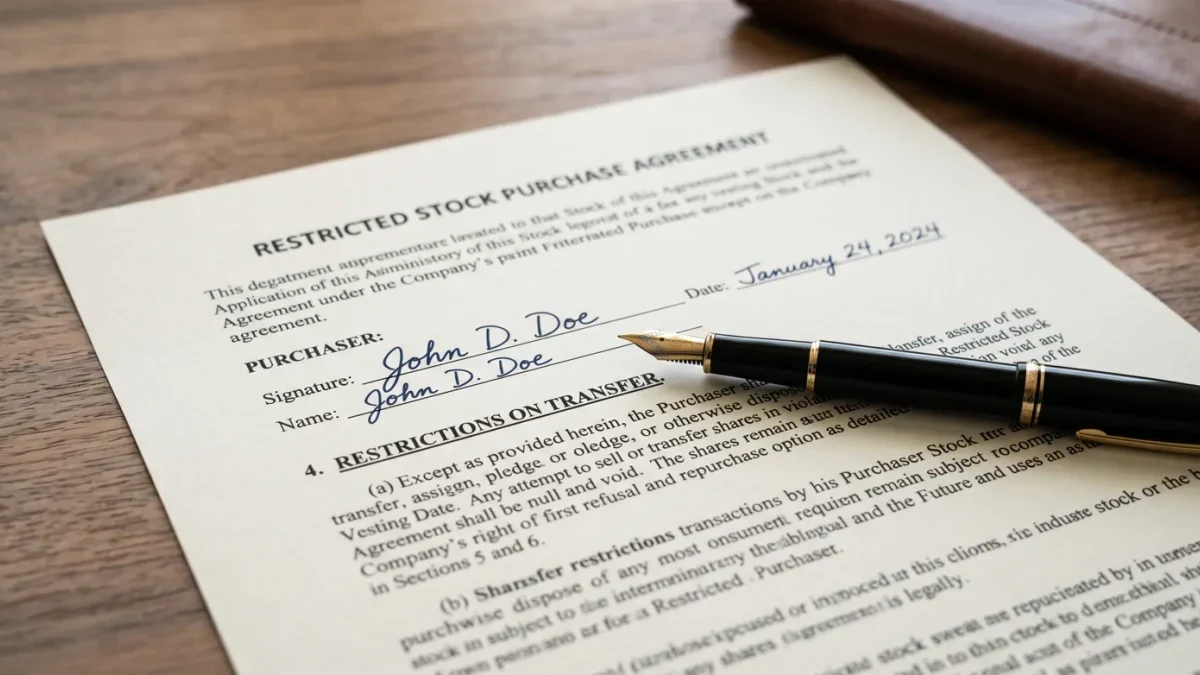
Founder vesting means your equity is earned over time rather than owned outright on day one: shares vest in monthly increments after a cliff, and unvested shares return to the company if you leave. The standard is four years with a one-year cliff — nothing vested for the first twelve months, then a quarter of the grant at the cliff, then 1/48th monthly. It sounds like investors distrusting founders, and structurally it is: it removes the catastrophic scenario where a co-founder departs in month seven owning 25% forever, chilling every future round. But it equally protects the staying founders from the leaving one, and it's effectively mandatory — a company with unvested founder stock is uninvestable at any reputable fund.
Equity and tax mechanics carry real consequences — this is an explainer, not legal or tax advice, and specifics belong with startup counsel.
How does the four-year, one-year cliff schedule actually work?
Take a founder with 4 million shares (40% of a company) on standard vesting. Month 11: still employed, zero shares vested. Month 12: the cliff clears — 1 million shares (25% of the grant) vest at once. Month 13 through 48: 1/48th of the grant — about 83,000 shares — vests each month. If the founder leaves at month 14, they keep 1,083,000 vested shares; the remaining ~2.9 million unvested shares return to the company, usually to the pool for future hires. The shares are typically restricted stock subject to a repurchase right: the company owns everything unvested and can buy back vested-but-unissued portions per the agreement's exact mechanics — which is why the paperwork, not the handshake, defines what "vesting" means here.
What is an 83(b) election and why does the 30-day clock matter?
In the U.S., when you receive restricted stock, tax rules can treat each vesting event as taxable income at the then-current value — meaning a founder could owe income tax on shares worth real money years later, with no cash from the shares to pay it. The 83(b) election, filed with the IRS within 30 days of the stock grant, fixes the tax basis at the grant date, when founder shares are worth fractions of a cent. File it, and future appreciation is capital gains territory instead of ordinary income spread across vesting. Miss the 30-day deadline and the election is gone — no late filings, no exceptions — which is why "file your 83(b)s" is the first thing startup counsel says after incorporation and the most expensive sentence in founder finance when skipped.
Why do investors insist on founders re-vesting?
Because they're funding the next four years of your work, not your past. At the first institutional round, unvested founders will be asked to subject some or all of their stock to a new vesting schedule — often keeping credit for time served. The negotiation points worth knowing: vesting credit for time already invested (common, ask for it), cliff reapplication (sometimes waived for founders with a year or more of history), and what happens at acceleration events. The ask that matters most is proportionality: founders two years in shouldn't accept a full reset to day one, and reasonable investors don't ask.
What are single- and double-trigger acceleration?
Acceleration clauses decide what happens to unvested shares when the company is acquired. Single trigger: all (or part) of your unvested equity vests immediately on a change of control. Double trigger: vesting accelerates only on change of control plus your termination without cause — you're protected if the acquirer fires you, but not paid twice if you keep your job. Acquirers strongly prefer double trigger, because single-trigger obligations show up on their balance sheet as instantly owed compensation and can complicate deals. The market standard for founders is partial double trigger (often 12–24 months of acceleration) or none at all — the negotiation is legitimate territory, but a single-trigger demand has scuttled more than one acquisition.
What should co-founders negotiate between themselves?
| Term | Common pattern | Notes |
|---|---|---|
| Vesting length | 4 years, 1-year cliff | Uniform across founders; individual side-deals corrode trust |
| Cliff length | 12 months | Shorter (6 months) for late-joining co-founders is seen |
| Cause definitions | Negotiated carefully | "Cause" termination can void vesting; define it narrowly |
| Leaver terms | Good/bad leaver distinctions | Bad leavers may lose even vested shares at a discount — read closely |
Per guidance in the U.S. Small Business Administration's business planning resources, ownership terms belong in written agreements from the start — vesting between co-founders is exactly the provision that no one misses until the month it's needed.
FAQ
Put vesting in place at formation, file the 83(b) within 30 days, expect re-vesting at the first round, and prefer double-trigger acceleration if any. The paperwork costs an afternoon; skipping it costs companies.