Your first ten customers come from manual, founder-led work: a named list of specific people you contact personally, communities where your buyer already gathers, and offers narrow enough that they don't read as marketing. The founder who waits for a website to produce customers confuses two phases — the first ten are sold, never marketed. The good news is that the manual phase is also the learning phase: every one of those ten conversations tells you what the product actually is, in the words of people paying for it.
This is a sales-process guide, not a growth playbook; the channels scale to different sizes and deserve revisiting once you have twenty-five customers.
Where do the first ten actually come from?
In rough order of hit rate for most early companies: your own network's second ring — not friends, but former colleagues, clients, and the people they'll introduce you to when asked specifically; communities you genuinely belong to — the Slack groups, forums, and subreddits where your buyer talks shop, entered as a contributor, not a billboard; a named outbound list — fifty to two hundred companies or people who match the ideal profile, contacted personally; adjacent buyers of a complementary product — the users of tools your product works alongside; and marketplaces and directories where buyers already search. The pattern across all five: specificity beats volume. One well-chosen community thread outperforms a hundred cold emails, and one warm introduction outperforms both.
What do you actually say?
Not an elevator pitch — a specific hypothesis and a small ask. "I'm building a tool that cuts invoice reconciliation for agencies from two days to two hours. I saw [Company] posted about month-end crunch — is that still eating your team's time? Happy to show what I have; if it doesn't fit, I'd value ten minutes on how you handle it now." The structure: name the buyer's pain in their vocabulary, cite something real you know about them, make the ask small, and offer the conversation as valuable even without a sale. Per the U.S. Small Business Administration's guidance on early customer research, direct conversations with target buyers are the cheapest and most reliable validation a new business can run — your first ten pitches are market research that occasionally closes.
Should you charge from customer one?
Yes, at some price — discounted, founding-customer, even manual-service-behind-the-product — but paid. Free pilots produce feedback about politeness; paid ones produce feedback about value, because paying customers tell you the truth and come back with problems that need solving. A founding-customer offer does real work here: a visible discount and direct founder access in exchange for weekly feedback and a testimonial if it works. Structure it time-boxed — ninety days, then the discount expires — so the early pricing never fossilizes into the permanent one. If nobody among your first ten conversations will pay anything, the problem is upstream of sales, and you've just learned the cheapest lesson available.
How do you run the manual process without chaos?
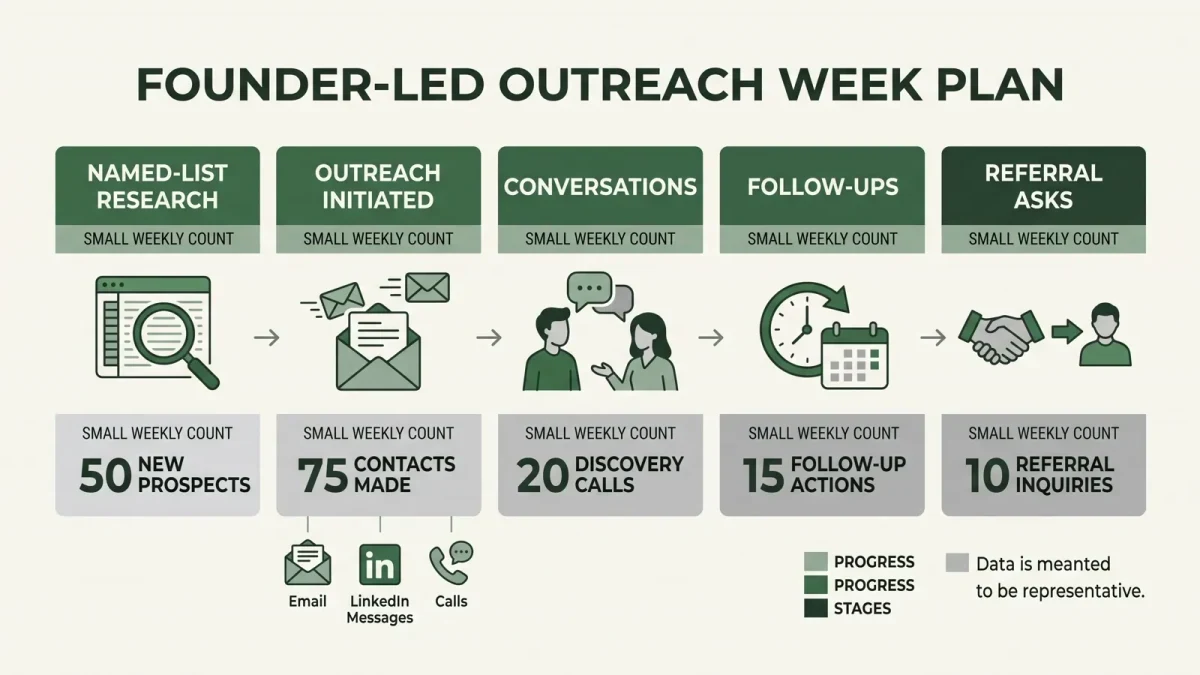
| Stage | What it looks like | Tools |
|---|---|---|
| List | 50–200 named targets with a reason each fits | Spreadsheet is fine |
| Contact | Personal messages, 10–15/week, no sequences yet | Email + LinkedIn/community |
| Conversation | 20-minute calls: their process, costs, current tools | Notes template per call |
| Offer | Specific, small, priced, time-boxed | One-page proposal |
| Follow-up | Every open thread touched weekly | Calendar discipline |
The weekly rhythm matters more than any tool: fifteen new contacts, every open thread followed up, notes from every call reviewed for the pattern that becomes your positioning.
What do you do with the first ten once you have them?
- Interview each one twice: at onboarding (why now, what almost stopped them) and at first success (what moment made it worth it). Those two quotes are your homepage.
- Over-deliver visibly: white-glove onboarding, founder response within hours. Early retention sets the word-of-mouth baseline.
- Ask for the referral explicitly: "who else has this problem like you do?" — the second ten are hiding in the first ten's contact lists.
Then stop selling manually the day the manual channel produces more conversations than you can run — that's the signal the positioning works and a repeatable motion can be built from the notes you took. Sell the first ten by hand, write everything down, and let the tenth customer's words become the marketing you couldn't have written on day one.