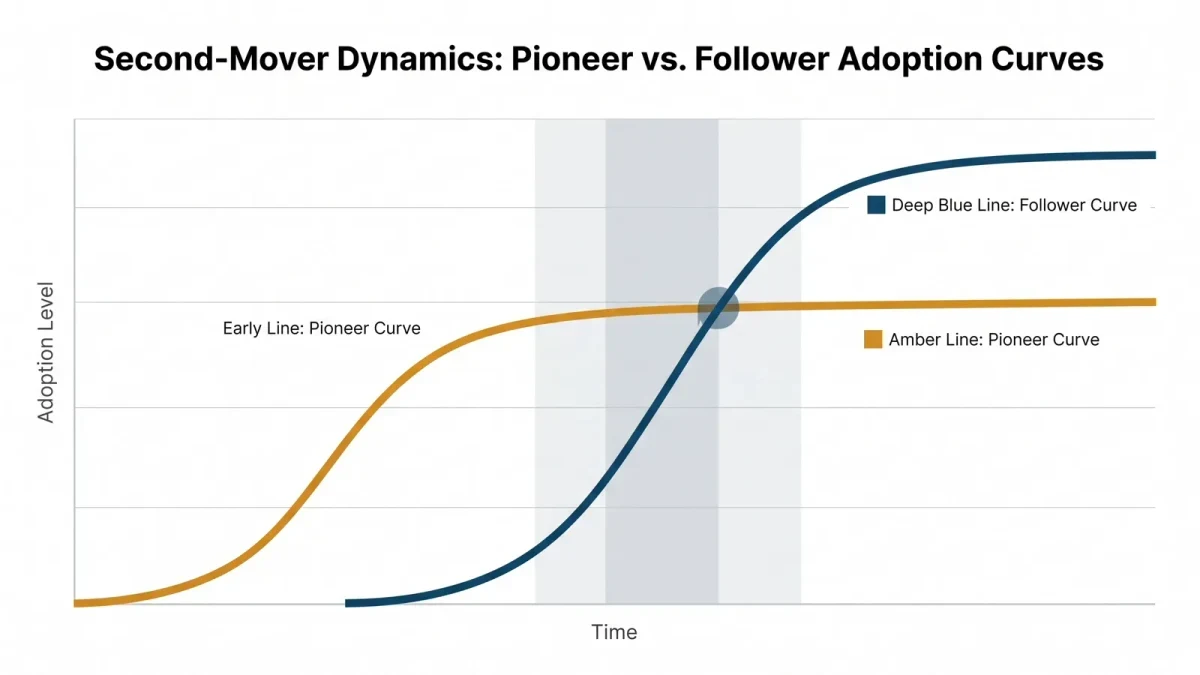
Being second is an advantage when you exploit what only a late entrant can see: the pioneer has validated the demand, educated the buyers, and published — through its own churn, pricing mistakes, and roadmap detours — a detailed map of what doesn't work. The second mover's playbook is to read that map, then attack a weakness that is structural to the incumbent rather than incidental: a business model that can't serve the lower end, an architecture that can't adapt to a new workflow, a sales motion too heavy for the segment now forming at the bottom. History's examples are household names — Google trailing a crowded search field, Facebook after Friendster and MySpace — and the mechanism is repeatable: pioneers pay market-education costs, fast followers collect the learning.
This is a strategy explainer, not a market analysis of any specific company.
What does the pioneer give the second mover for free?
Three assets. Demand proof: someone is already paying for the category, so the "will anyone buy this?" risk is retired — the question narrows to "why switch to you?" Educated buyers: the category's vocabulary, evaluation criteria, and budget lines exist; your marketing explains a difference instead of teaching a concept. A public error log: the pioneer's pricing experiments, feature sprawl, support reputation, and churn complaints are all observable — read the review sites, the migration guides, the community threads, and count what customers complain about for a year. That complaint ledger is the closest thing strategy has to free proprietary research.
Where does the attack usually come from?
| Attack vector | Mechanism | Why the pioneer can't respond |
|---|---|---|
| Price/bottom of market | Serve the segment the pioneer's pricing excludes | Cannibalization: matching you cuts their revenue |
| Workflow-native rebuild | Build for how the job is done now, not how it was done at founding | Legacy architecture and installed base |
| Segment depth | Out-serve one vertical the pioneer treats generically | Generalist sales and product can't go niche-deep |
| Business-model inversion | Sell what they give away, give away what they sell | Their P&L depends on the current arrangement |
The shared property: each attack exploits a constraint the incumbent would have to hurt itself to remove. Competing on features instead — matching the pioneer's product and adding more — is the one attack that plays to their strengths.
How fast is too fast to follow?
Enter after demand is validated but before the pioneer has consolidated — practically, when the category has real paying customers, visible complaints worth attacking, and no dominant trust network yet. Enter too early and you pay the pioneer's education costs alongside them with fewer resources; enter too late and you fight a reference-fortified incumbent in a commoditizing category. The 2026 market adds a wrinkle: with AI-related companies absorbing roughly 90% of global venture funding in February 2026 per Crunchbase News, category clocks in AI-adjacent markets run fast — validation arrives in quarters, not years, and the "too late" boundary arrives just as quickly. Speed of the follow matters more in fast clocks; depth of the wedge matters more in slow ones.
What does a second-mover wedge look like in practice?
One sentence with three parts: the underserved buyer, the structural weakness attacked, and the proof. "We serve the [segment] that [pioneer]'s per-seat pricing prices out, with the same core outcome at a tenth of the cost, backed by a free migration tool." The migration tool is not decoration — switching costs are the pioneer's best defense, and the second mover's go-to-market must include an answer: importers, compatibility modes, dual-run periods. Reduce the switching friction to near zero and the incumbent's accumulated lock-in becomes merely their installed base's inconvenience.
What are the second mover's failure modes?
- Clone positioning — "like X but better" with no named structural weakness, which forces a feature war you'll lose on resources.
- Pioneer envy — abandoning the underserved segment the moment the pioneer notices you, which is exactly when doubling down works.
- Over-reading the map — copying the pioneer's current product rather than fixing its founding errors; you inherit the mistakes with none of the trust.
- Waiting for perfection — the wedge ships when it's 10× for the underserved buyer, not when it matches the incumbent feature-for-feature.
The last one is the most common: second movers die of building the full clone before finding their first hundred switchers.
When is first actually better?
When network effects or data loops decide the category early — marketplaces, exchanges, systems of record with strong lock-in — being late is close to fatal, and buying or partnering into the network is the only rescue. The honest pre-entry analysis: does this category compound advantage toward whoever got there first? If yes and you're second, look for the sub-segment where the network doesn't reach. If no — most tools and workflows — the pioneer's lead is a cost of education, not a fortress. Read their error log, aim at what they can't fix, and make leaving them easy.