Your price is a hypothesis about what the outcome you deliver is worth to a specific buyer, and you test it the way you test any hypothesis: with real asks, real hesitations, and controlled changes — not with cost-plus arithmetic or a competitor's price page copied at a 10% discount. The highest-leverage pricing move most founders never make is simply asking more: a 10% price increase that holds win rate adds more to profit than most growth initiatives add in a year. The second-highest-leverage move is packaging — splitting one product into good/better/best tiers so different willingness-to-pay sorts itself.
Pricing interacts with tax, contracts, and consumer law; this is a strategy guide, not professional advice.
Why does cost-plus pricing fail for software and services?
Cost-plus anchors to your inputs, but buyers pay for outputs: hours saved, revenue recovered, risk avoided. The same workflow automation is worth $30/month to a solo freelancer and $3,000/month to a mid-market team — identical cost to serve, tenfold different value captured. Value-based pricing starts from the buyer's arithmetic: quantify the outcome in their units (per the buyer's own numbers — hours per week, cost per error, revenue per campaign), price a fraction of that value, and be able to show the math in the sales conversation. The pricing conversation and the value conversation are the same conversation; founders who fear the number usually haven't done the value math out loud with enough customers.
How do you structure tiers that actually sort buyers?
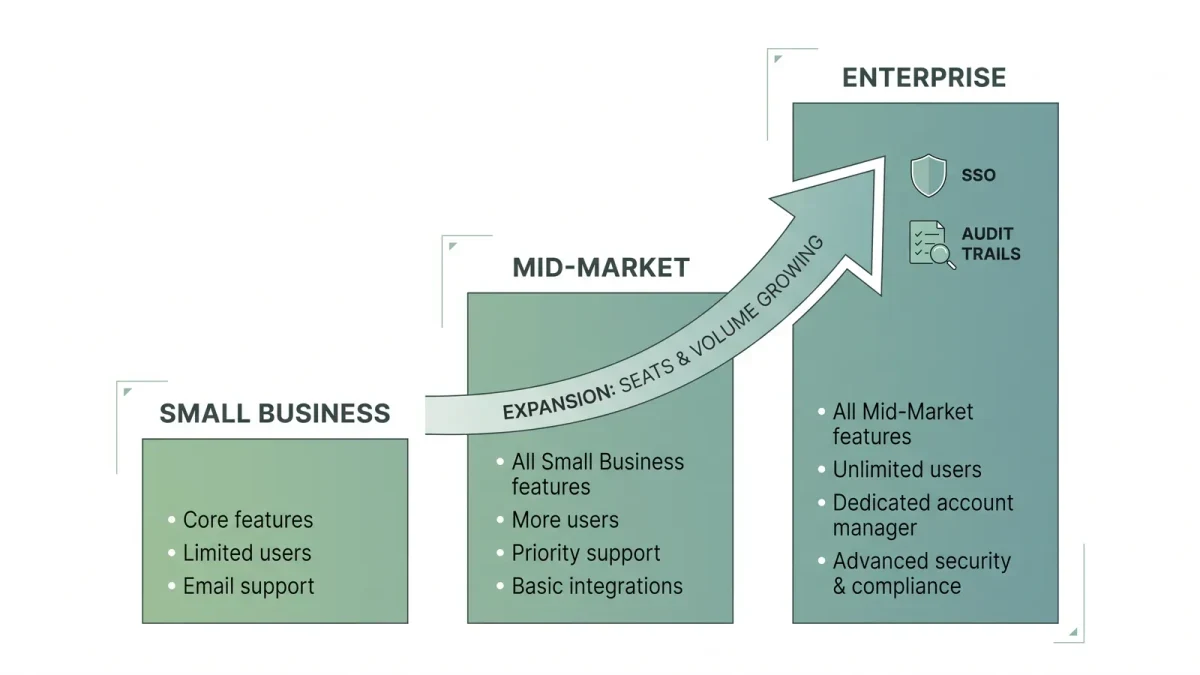
Three tiers, differentiated by the buyer's situation rather than by feature cruelty. A workable pattern: free or cheap tier sized for an individual team proving the tool works; core tier priced for the working team that gets the full outcome; enterprise tier priced for the organization around the team — SSO, audit logs, compliance, support SLAs. The upgrade triggers should be things that happen as the customer succeeds (seats, volume, org requirements), so growth in their business mechanically grows your invoice — expansion revenue, the cheapest revenue there is. Avoid the pricing-page antipatterns: seven tiers nobody can choose between, and a single price that forces your most valuable buyers to negotiate from scratch.
How do you test price without blowing up the funnel?
Small, controlled, reversible changes. The standard toolkit: anchor tests — quote a higher number to the next ten qualified prospects and watch the objection pattern, not just win rate; optional upgrades — add a premium option and see who self-selects up; grandfathered increases — raise the price for new customers only, keeping existing customers whole, which isolates the effect and protects trust. Instrument the questions: when prospects stop asking "why so much?" and start asking "what's included?", the price has moved inside the defensible range. Test one change at a time, on similar cohorts, and write down the result — the pricing log becomes the company's most valuable strategy document.
What pricing models fit which products?
| Model | Fits when | Watch out for |
|---|---|---|
| Per-seat | Value scales with users | Seat-sharing suppresses revenue as teams get leaner |
| Usage-based | Value scales with volume (APIs, AI workloads) | Unpredictable invoices chill adoption; add caps and alerts |
| Flat subscription | Value is broad and constant | Leaves money on the table at the top; negotiate enterprise separately |
| Outcome/percentage | Measurable revenue outcomes | Requires trusted measurement; procurement fights the meter |
Hybrids are increasingly the norm — a platform fee plus usage — because they let buyers start small and grow predictably.
How do you raise prices on existing customers?
Announce early (60–90 days), grandfather generously or phase the increase, tie it to something real (scope, support, roadmap), and personally contact the top accounts before the email blast. Expect to lose a tail of price-sensitive accounts and compute that loss honestly against the increase — most founders overestimate the churn a raise causes. A market context worth naming: input costs for many software businesses rose through 2025–2026 — cloud and AI inference are the visible lines — while per Federal Reserve statements the policy rate sat at 3.50–3.75% by early 2026 after the December 2025 cut, keeping capital costs non-trivial for customers too. Both facts push the same direction: annual prepay discounts protect your cash, and defensible value pricing protects your margin.
What are the signs your pricing is wrong?
- A 90%+ win rate with almost no negotiations — you're underpriced, full stop.
- Every deal requires a custom discount — the list price is fiction.
- All revenue in one tier — the other tiers are decoration.
- Churn price objections outnumber value objections — the value math never landed.
Any one of these is a test to run this quarter. Price the outcome, package the buyer's growth, test in small increments, and write every result down. Then stop apologizing for the number.