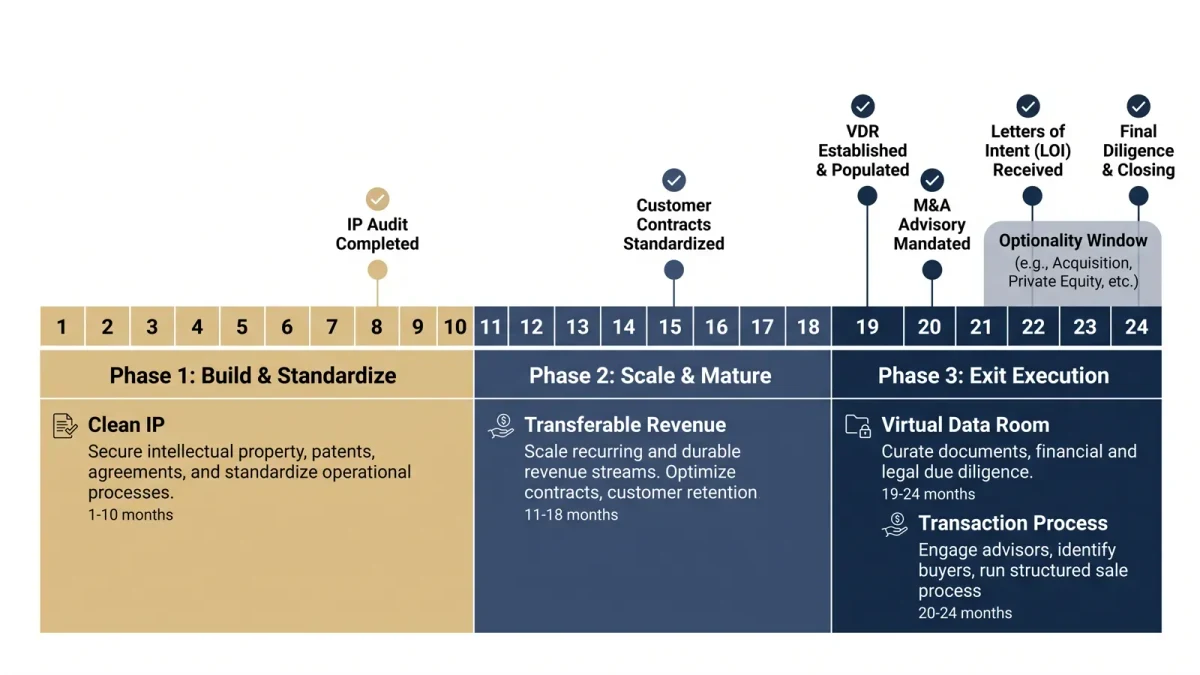
Exit planning is not planning the sale date; it's building the company so a sale — or a financing, or a merger — is possible at a decent price whenever the right moment arrives. Acquirers pay premiums for transferability: revenue that survives the founder's departure, IP that is actually owned by the company, contracts assignable without consent gymnastics, and books that survive diligence without a rewrite. Founders who defer this until an LOI is on the table discover that twelve months of pre-sale cleanup could have been twelve months of building — and that the cleanup discount was applied to their valuation anyway.
This is an operational guide, not M&A or legal advice; every transaction needs experienced counsel and tax planning.
What actually makes a startup saleable?
Five transferability traits, all buildable in the ordinary course. Clean IP: every contributor — founders, contractors, employees, open-source dependencies — assigned or licensed properly, from day one; the open-source audit especially, including what your AI-era codegen practices pulled in. Distributed key-person risk: documented processes, a management layer that runs quarterly without the founder, customer relationships held by the company not one person's phone. Transferable revenue: contracts with standard assignment clauses, diversified concentration (no customer above ~20–30% of revenue), churn low enough that projections aren't fiction. Clean books: accrual accounting, a data room that exists before it's needed. A legible story: the acquirer can state in one sentence why buying you beats building — a segment, a data asset, a capability, or pure financials. Per Bureau of Labor Statistics business dynamics data, the majority of successful small-firm exits follow years of stable operations rather than auction drama — readiness compounds quietly.
What are the exit paths, realistically?
| Path | Typical buyer logic | Founder priority |
|---|---|---|
| Strategic acquisition | Segment, tech, team, or data fits their roadmap | Build the one-sentence fit story early |
| Private equity | Cash flows, consolidation plays | Profitability and clean books over growth optics |
| Financial/acqui-hire | Team and product at a modest price | Preserve optionality; keep IP clean |
| Secondary sales | Late-stage investors buying founder shares | Company still independent; partial liquidity |
| Run it forever | Dividend-throwing ownership business | A legitimate strategy, named as one |
The 2026 market context matters for the first two rows: per Crunchbase News, AI-related companies absorbed roughly 90% of a record $189 billion global funding month in February 2026, and strategic acquirers have been paying premiums for AI-capable teams and data assets. If your exit thesis rests on strategic acquisition, the asset an acquirer would pay for — a data loop, a niche segment position — is a strategy-page item, not a sales-deck afterthought.
When should founders start planning?
The structural items start at incorporation: IP assignments, 83(b) elections, cap table hygiene, standard contracts. The strategic items — the fit story, concentration limits, process documentation — start once you have real customers (usually Series A or equivalent). The active items — the data room, the advisor relationships, the quarterly-ready financial package — start about two years before any intended process. The reason for the long runway is that most exits are optionality exercised, not calendars kept: inbound interest arrives unexpectedly, and the company with a data room ready in two weeks negotiates from a different position than the one that needs six months of cleanup. Two years of readiness also changes what you build — the documentation discipline that serves a sale serves the operating company every day before it.
What kills deals in diligence?
- IP gaps: the early contractor who never signed an assignment; the co-founder handshake equity that was never papered.
- Concentration: one customer at 40% of revenue reprices the whole deal, if it doesn't end it.
- Founder dependence: the acquirer realizes they're buying a job, not a company.
- Revenue surprises: commissioned deals booked as recurring, pilots counted as customers.
Every item is cheaper to prevent than to explain. The diligence discovery of a structural flaw doesn't just delay a deal — it re-teaches the buyer what kind of operator is selling.
How do founders align personal and company outcomes?
Understand your own instruments before the LOI: vesting and its acceleration clauses (single- vs. double-trigger, and what a merger means for unvested shares), liquidation preferences stacking across rounds and how the waterfall actually distributes at various prices, and option-plan treatment in a change of control. Model the waterfall at three exit prices — disappointing, expected, dream — and have tax counsel walk the numbers before term-sheet pressure, not during. Founders who learn their own waterfall math at signature time negotiate nothing; founders who modeled it a year earlier negotiated the terms that mattered. Build saleable, model the math, keep the data room warm — then run the company as if you'll own it forever, which is, not coincidentally, what makes it worth buying.