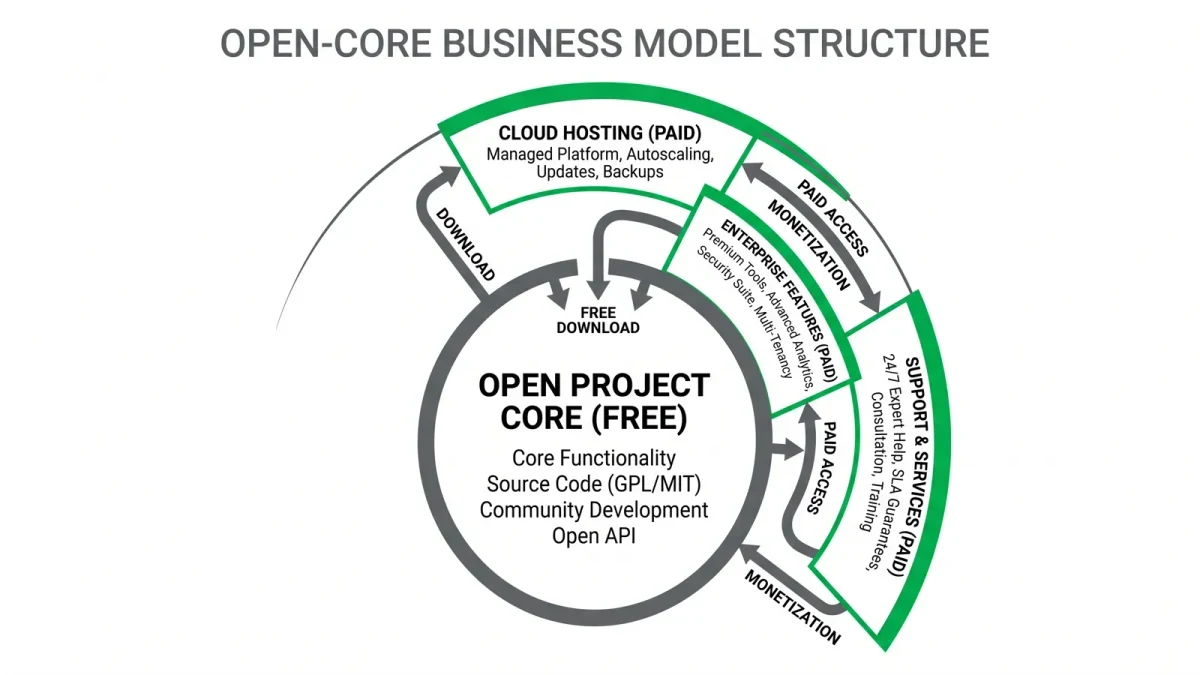
Open-source startups make money by selling what the license doesn't include: the managed cloud version, the enterprise features around the free core, or the support and compliance someone with a production outage needs at 3 a.m. All three models monetize the same reality — the gap between software that costs nothing to download and software that costs real money to run reliably. Choose the model before you choose the license, because the license determines which models stay open to you: a permissive license (MIT, Apache 2.0) invites adoption but lets any cloud vendor compete with your hosted product, while a copyleft license (AGPL and its variants) makes commercial re-wrapping harder and, in recent years, has become the default defensive choice for open-core infrastructure companies.
This is a business-model explainer, not legal advice; licensing decisions deserve counsel familiar with open-source law.
What is the open-core model and when does it work?
Open-core keeps the core project free and sells proprietary add-ons: single sign-on, audit logs, role-based access control, higher scale limits, analytics. The art is drawing the line so the free core is genuinely useful — that's what drives adoption, community contributions, and top-of-funnel — while the paid layer targets what companies, not hobbyists, need. The common failure is a starving core: features held back so aggressively that the free version can't reach production, killing the adoption engine the model depends on. The second failure is the reverse — an open core so complete that only compliance-driven enterprises ever pay. A workable heuristic: the free tier should serve an individual team fully; the paid tier should serve the organization around it.
What is the managed-cloud model?
You sell the open-source project back as a hosted service: the customer pays to not run it. This is frequently the largest revenue line for infrastructure projects, because operations — upgrades, backups, scaling, security patching — is precisely the pain self-hosters feel most. The strategic hazard is the hyperscaler problem: under permissive licenses, a large cloud provider can offer your project managed at a scale you can't match, which is the history that pushed several notable database and infrastructure companies toward restrictive licenses or the Business Source License. The cloud model works best when operating the software requires rare expertise your team demonstrably has — the project's own maintainers running the project is a real product.
What about support, services, and the compliance layer?
The oldest model: subscriptions for support SLAs, security patch delivery, certification, and training. Historically dismissed as consulting revenue with worse margins, it has aged better than expected in regulated and enterprise contexts, where a named human and a contractual response time are procurement requirements, not luxuries. Its ceiling is real — support revenue scales with headcount more than with usage — but as a wedge alongside open-core or cloud it converts the most conservative buyers. Some companies structure the same demand as an "indemnification and compliance" product, which is support re-priced for the legal department.
How do the models compare?
| Model | Revenue quality | Main risk | Best fit |
|---|---|---|---|
| Open-core | Software margins, feature-gated | Starving the core or giving away the org layer | Developer tools, collaboration, security products |
| Managed cloud | Software margins, usage-based | Hyperscaler competition under permissive licenses | Infrastructure: databases, queues, observability |
| Support/compliance | Lower margin, headcount-tied | Scaling ceiling | Regulated industries, conservative enterprises |
Most successful open-source companies run two of the three at once — cloud plus an enterprise feature tier is the common pairing — with the free project as shared top-of-funnel.
What does the market context look like as of 2026?
The funding environment has treated the category well while concentrating. Per Crunchbase News reporting, AI-related companies absorbed roughly 90% of global venture funding in February 2026 — $171 billion of a record $189 billion month — and a meaningful share of open-source infrastructure winners ride that wave, since model weights, inference engines, and data pipelines are natural open-source categories. The corollary: open-source projects without an AI narrative now pitch against a smaller pool of growth capital, which sharpens the premium on picking the monetization model before scaling community spend. Community adoption remains the moat that matters — download counts and contributor graphs are the demand evidence investors price — but adoption without a conversion path is a charity with extra steps.
How should a founding team sequence the decision?
- Pick the monetization model first; let it drive license choice.
- Design the free/paid boundary around team versus organization, not around cripple-ware.
- Instrument the conversion funnel from the first release: self-hosters who ask about SSO are your pipeline.
- Revisit the license only with counsel and community notice — license changes burn trust that funds the whole model.
The software is free; the reliability, the org features, and the 3 a.m. pager are the product. Decide which of those you sell, license accordingly, and keep the core generous enough to grow the funnel that pays for everything. Then stop apologizing for charging.