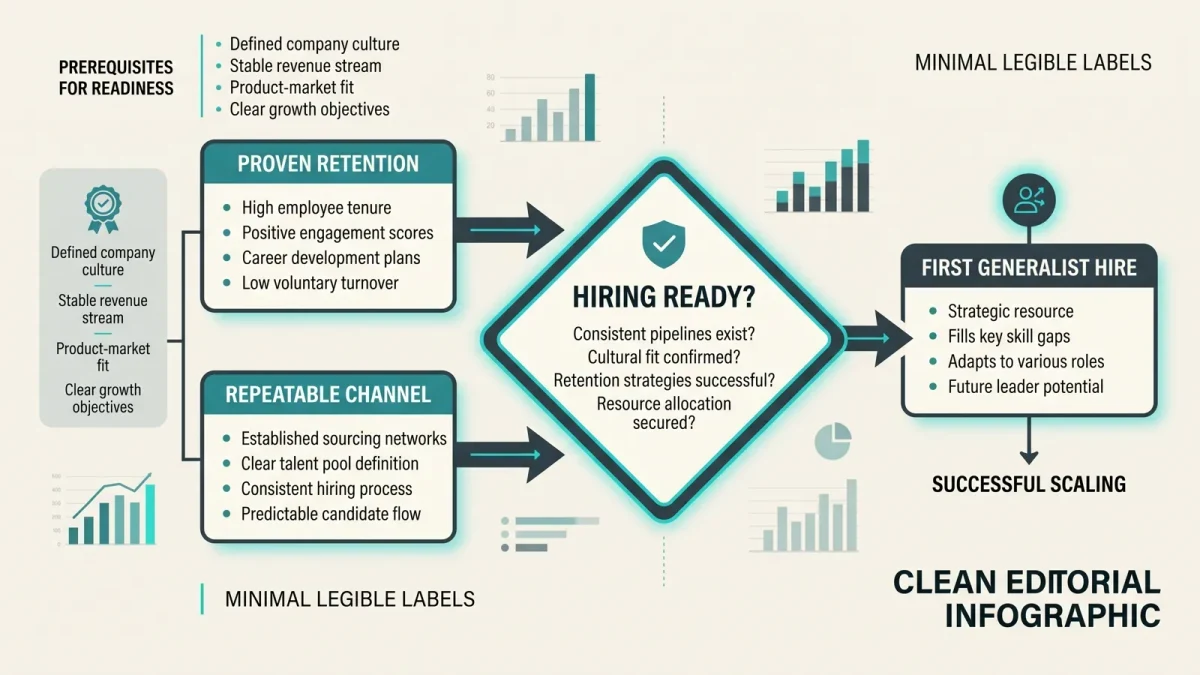
You hire a growth team when two preconditions are true: retention is proven (the product holds users without heroics) and at least one acquisition channel works repeatably with the founder still running it. The team's job is not to discover growth from zero — it's to industrialize what the founder proved and then explore systematically adjacent channels. Companies that hire growth earlier buy an expensive experiment team that re-learns what the founder hasn't tested, while the product's leak empties whatever funnel they build.
This is a hiring-and-operations guide, not a growth audit of your company; the preconditions deserve your own data before any requisition.
Why does the order matter so much?
Because growth work amplifies what exists. A growth team pointed at a leaky product generates churn with better attribution; a growth team pointed at zero working channels flounders for two quarters and quits in frustration — the pattern behind the "growth hires never work" folklore. Per Census Bureau data on young-firm performance, survival and growth track repeatable process quality, and a repeatable channel is exactly that: the market's evidence that your acquisition process works at small scale. The founder-led phase isn't a cost of getting to the growth team; it's the due diligence that makes the hire a scaling decision instead of a lottery ticket.
What does the first growth hire look like?
The first hire is a growth engineer-generalist or a growth lead with hands — someone who can instrument, run experiments end-to-end without tickets, and do the analysis themselves, because at this stage "growth team" is one or two people plus the founder. Red flags on both ends of the spectrum: the pure strategist who has never run an experiment alone (decks, not pipelines) and the pure performance marketer who only knows paid spend (one channel, rented). The interview is a working session on your actual funnel — a teardown of your onboarding, three prioritized hypotheses, and a design for the first experiment. The candidates who ask for your cohort data before proposing anything are the ones to shortlist.
What must exist before they start?
| Prerequisite | Why it's non-negotiable |
|---|---|
| Instrumentation | Events, cohorts, funnel tracking live — experimentation without measurement is superstition |
| Baseline metrics | Activation, retention, CAC by channel — the team needs a before to prove an after |
| Experiment budget | Fixed spend with kill thresholds, approved in advance — mid-quarter budget fights kill momentum |
| Shipping authority | Deploy access and a lightweight approval path for A/B changes |
| The founder's playbook | Documented what-worked and what-didn't from the founder-led phase |
The last row is the most underrated: the founder's experiment log converts six months of intuition into a starting map, and its absence costs the new hire their first quarter rediscovering it.
How should the team be structured as it grows?
From one generalist to a pod model: small teams of two to four — an engineer, a designer, an analyst or marketer — each owning a surface (activation, monetization, referral, a channel) with its own metric and experiment budget. Pods outperform functional silos (all marketers here, all engineers there) because growth work dies in handoffs; a pod that ships end-to-end compounds its own learning. Headcount honesty: this phase typically follows Series A economics — per Crunchbase News's full-year tally, U.S. startups raised $328 billion in 2025, and growth-team scaling is one of the line items that separates companies raising from companies demonstrating efficiency; the burn-multiple discipline applies to headcount as much as to ads.
What are the failure patterns?
- The fireworks hire: a big-name growth leader onto a pre-fit product — nine months of impressive dashboards, flat revenue, mutual disillusionment.
- The pod without a metric: teams running experiments with no single north-star surface metric; every test is judged by vibes, and nothing compounds.
- Tool sprawl first: quarter one spent evaluating experimentation platforms instead of running experiments on the funnel that already works.
- Founder abandonment: the team arrives and the founder disengages — growth loses its escalation path exactly when the hard organizational questions start.
Each pattern is an order-of-operations error, not a talent error — which is the comforting part, because order is free to fix.
How do you know the team is working?
Within two quarters: an experiment cadence (several meaningful tests shipped per pod per month), an improving headline input metric per surface (activation, conversion, referral participation), and CAC or payback trending better on the industrialized channel. If cadence is high but metrics are flat for two quarters, the problem is usually upstream — targeting, offer, or the product itself — and the honest move is redirecting the pods at retention before acquiring anyone new. Prove retention, prove a channel, write the playbook, then hire one generalist with instrumentation and budget waiting. Then let the pods compound — and stay close enough to break the ties.