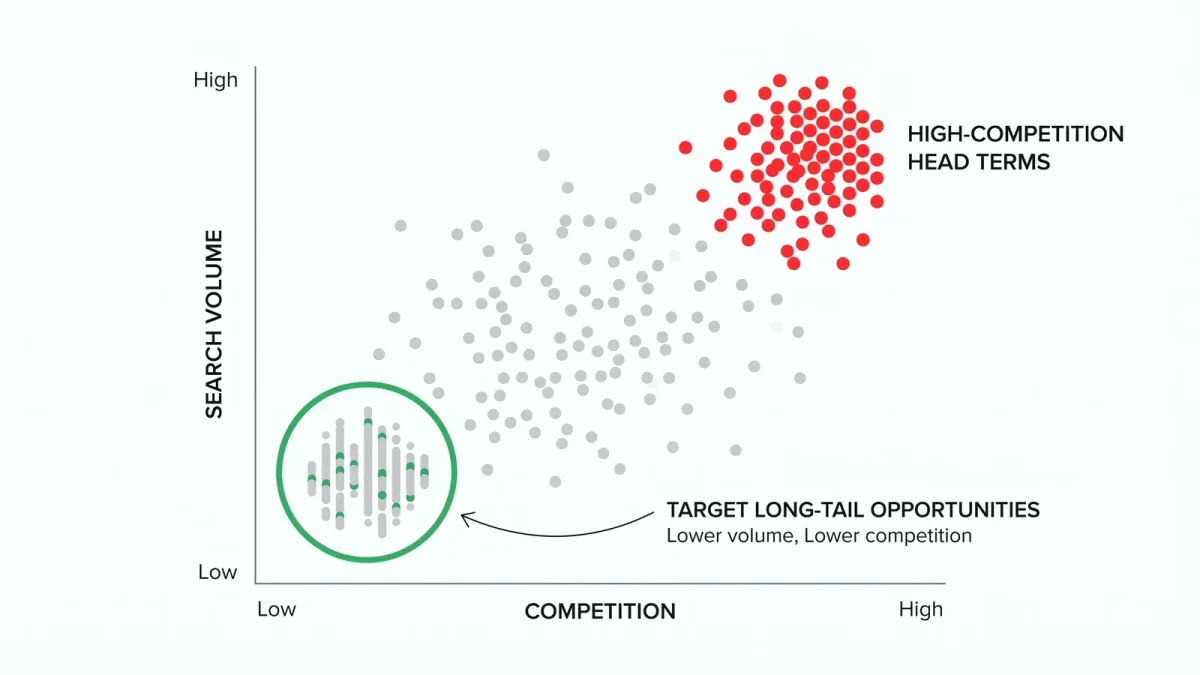
Startup SEO works when it's built on narrow, high-intent queries where incumbents haven't bothered — "invoice reconciliation for agencies," not "invoicing software" — and when it's understood as a compounding asset with a 6–12 month fuse, not a growth lever for this quarter. The strategic choice is which battles to skip: head terms belong to a decade of accumulated authority you don't have, and chasing them burns the team's morale and the content budget on page-four results. The long-tail, intent-specific strategy is slower per article and, in aggregate, becomes the cheapest durable channel a small company can own.
This is an organic-growth guide, not a promise of rankings; search algorithms change, and the fundamentals below are the durable part.
What's the realistic strategy for a site with no authority?
Three layers, built in order. Layer one — capture demand you create: brand queries, comparison pages ("[You] vs [Alternative]" for every competitor), pricing and integration pages. These convert at the highest rate because the searcher already knows you. Layer two — narrow problem queries: the long-tail of specific pains your product solves, where specificity is the moat — a five-part guide to a niche workflow nobody at the incumbents would be paid to write. Layer three — programmatic depth: templated pages generated from structured data (integrations, templates, benchmarks by segment) that scale content in a way a five-person team can maintain honestly. Each layer feeds the next: layer-one pages earn the conversions, layer-two earns the topical authority, layer-three earns the breadth that makes the site the category's reference.
How do you pick keywords honestly?
| Signal | Target | Why |
|---|---|---|
| Monthly volume | 100–2,000 for narrow terms | Head terms are authority auctions you'll lose |
| Intent | Transactional or problem-stated | "How do we stop overpaying SaaS tools" beats "SaaS trends 2026" |
| Competition | Weak or generic results on page one | Forums and thin listicles are beatable; two vendors' guides aren't |
| Fit | Searcher could use your product | Traffic without fit inflates vanity, depresses conversion |
The honest filter that saves the most time: would a searcher who finds your page be better off, and could they plausibly buy? If either answer is no, skip the keyword regardless of volume.
What does execution look like at startup scale?
- Technical minimums first: fast pages, clean crawl, sitemaps, no index bloat — the boring foundation that makes everything else possible; per the U.S. Small Business Administration's digital presence guidance, the basics of discoverability remain the highest-ROI technical work for small businesses.
- One page per intent, done properly: comprehensive, genuinely useful, updated on a schedule; ten excellent pages beat a hundred thin ones in every algorithm era.
- Distribution, not publication: each page gets shared where its audience lives — communities, newsletters, partners — because early links come from people, not from publishing.
- Measurement: track assisted conversions and branded-search growth, not raw sessions — SEO's compounding shows up as branded queries rising month over month.
The common startup failure is the opposite cadence: sixty AI-assembled articles published in a month, nothing updated, nothing distributed, and a content graveyard that the next algorithm update deindexes wholesale.
How does AI change the calculus in 2026?
In two directions. Search results increasingly carry AI-generated answers, pushing informational click-through down — which raises the value of queries where the searcher needs your specific capability (comparison, integration, pricing, niche workflow) and lowers the value of generic explainers everyone can generate. And content production costs collapsed, which means volume is no longer a differentiator anywhere — experience, data, and specificity are. The defensible assets are the ones AI can't synthesize: your product's usage data, your customers' benchmark numbers, your integration how-tos. Per Crunchbase News reporting, AI companies took roughly 90% of global venture funding in February 2026 — the whole market is building on the same models, so the content that ranks is the content with something the models don't have.
When should a startup skip SEO entirely?
When the product creates a category nobody searches for yet — no query volume exists to win — or when the sales motion is outbound and the ACV supports it without inbound. In both cases, do the technical minimums and layer one (capture your own brand demand), and spend the rest of the energy on the channels that compound faster for your stage. For everyone else: pick the narrow queries, build the three layers, measure branded search rising. Then keep publishing the pages only you could write.