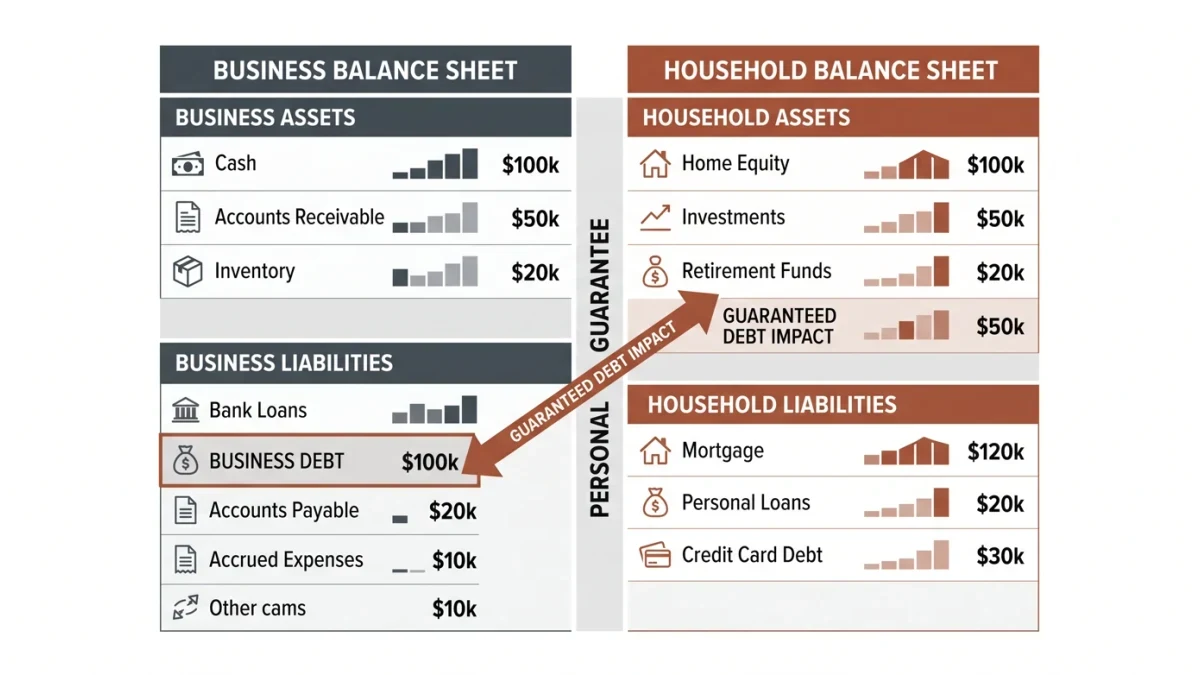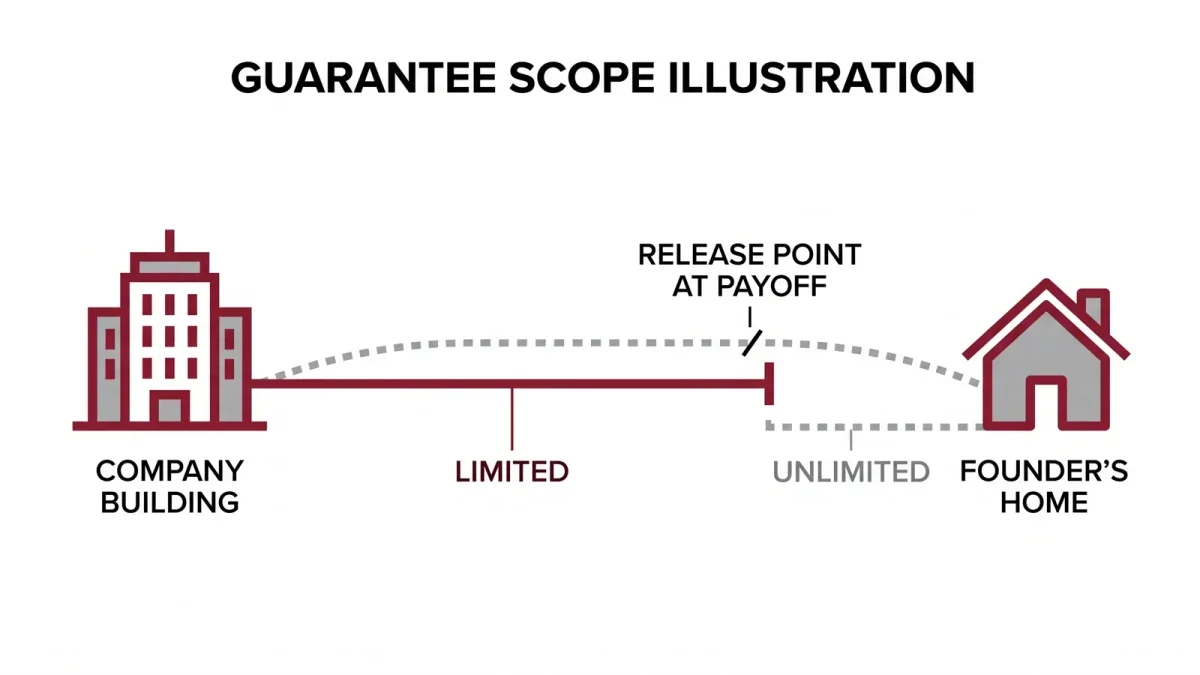
A personal guarantee is your promise to repay a business debt personally if the business cannot: the lender's claim jumps the corporate veil and lands on your house, your savings, and your future income. Most small-business lenders require one — with a personal guarantee, per the U.S. Small Business Administration's financing guidance, a loan is effectively backed by the owner's assets — and most founders sign one while focused entirely on the interest rate. The rate is negotiable later; the guarantee's scope is negotiated only now, at signature. Read it as what it is: an unsecured loan to you, wearing the business's name.
What exactly does a guarantee commit you to?
Read four attributes in any guarantee clause. Coverage: limited (capped at a fixed amount) versus unlimited (everything you owe, plus fees, plus collection costs — the default if unspecified). Trigger: typically any default, not just insolvency — a missed covenant can technically activate it. Duration: some guarantees survive the specific loan they secured and cover future borrowings on the same facility; look for language about "all indebtedness." Security behind it: whether the lender also takes a lien on specific personal assets, which changes what a discharge actually protects. The collective effect of the fine print: two founders with identical loan amounts can carry wildly different personal exposures depending on four clauses nobody compared.
When is signing one rational?
When three conditions hold together: the loan buys an asset or capability with a measurable payback (equipment with known utilization, inventory with proven turns — not runway to "figure out revenue"); the projected cash flow services the debt with real cushion even in a downside case; and your personal balance sheet survives the worst case — you can articulate what you'd actually lose, and accept it. The guarantee is effectively your equity investment in the deal: lenders price it, and the honest mental model is that you've invested up to the guarantee amount at the loan's terms. Per Federal Reserve statements, the policy rate ended 2025 at 3.50–3.75% after the December cut — borrowing costs are moderate by the last decade's range, which makes the arithmetic legible but doesn't soften the guarantee's tail risk at all.
What can you negotiate?
| Term | Ask for | Why lenders sometimes accept |
|---|---|---|
| Coverage cap | Guarantee limited to the loan principal or 50–75% of it | Partial recourse still materially de-risks the loan |
| Burn-down | Guarantee steps down as the balance amortizes | Exposure tracks collateral value |
| Sunset | Guarantee releases after N on-time payments or a refinancing | Payment history is the real risk signal |
| Spousal scope | Only the owner signs, not both spouses; exclude jointly-held assets where state law allows | Business logic doesn't require the spouse's credit |
Negotiating leverage scales with how much the lender wants the deal: strong cash flow, collateral, or a competing offer move the terms. The guaranteed-approval lender with no questions asked isn't being friendly — it's pricing the guarantee as the actual collateral.
What happens when a guarantee is called?
The lender pursues you personally for the unpaid balance — settlement negotiations, then potentially judgment and liens on personal assets, varying by state's property rules (homestead protections differ materially). Two protective notes. First, bankruptcy discharge of a guarantee is possible but costly and state-dependent — plan as if it isn't. Second, if the business fails and the guarantee is honored or settled, get the release in writing: a settled guarantee without a documented release can resurface in portfolio sales to collectors. Founders who navigated this cleanly share one habit: they negotiated the exit terms of the guarantee at signing, when goodwill existed, rather than at default, when it didn't.
What are the alternatives worth exhausting first?
- Revenue-based financing: repayment as a percentage of sales — no guarantee in many structures, priced higher.
- Equipment-secured lending: the asset is the collateral; personal exposure is smaller or none.
- SBA-backed loans: often require guarantees too, but with caps and standardized terms worth reading — the SBA's financing guide outlines when the full guarantee requirement applies by loan size.
- Customer financing: prepayments and annual commitments from real customers — capital that validates the business instead of mortgaging the founder.
Read the four attributes, negotiate the cap and the sunset, and match the borrowed purpose to a measurable payback. Then sign only what you could lose twice and still build again.