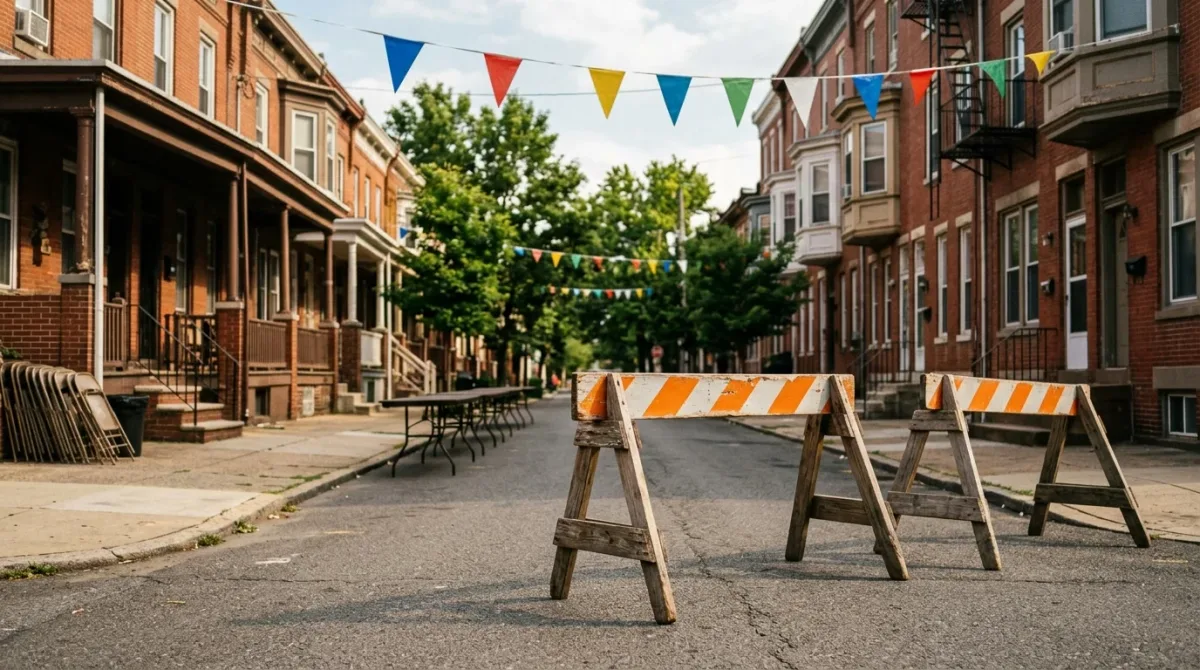
Anyone who wants to close a Jersey City street for a block party starts in the same place: the Office of Cultural Affairs at 280 Grove Street, Suite 105. The city asks for special event applications 60 to 120 days before the date, and says approval takes another 60 to 120 days after that.
That is the part most first-time organizers miss. A street festival, a block party, a 5K down Grand Street — none of them are a matter of putting up barricades and telling the neighbors. In New Jersey, the paperwork is municipal first and state second, and the two clocks run at different speeds.
Newark wants block party applications at least 21 days out. Asbury Park routes its applications through a committee and then to City Council. The rules below come from the cities' own permit offices and from the state Division of Alcoholic Beverage Control, and they are the same rules whether the event is a 40-person party on one block or a festival that draws a county.
Who Actually Needs a Permit?
If the event touches city property, city equipment, or city workers, it needs a permit. Asbury Park puts it plainly: a special events permit is required for any event that uses "City-owned property, City equipment or City services, including street closures, Police, Fire, EMS and Public Works services," according to the city's special events page.
Newark draws a line between two categories. Its Office of Special Events treats a block party as an outdoor residential event organized by block residents, nonprofits, or places of worship, and specifically non-commercial. A special event, by Newark's definition, is an organized activity on city property that requires municipal services to be coordinated around it.
Jersey City runs both through the same front door. Block parties there carry an extra condition: the Office of Cultural Affairs requires applicants to be part of a Jersey City-registered Block Association. A group of neighbors who have never formed one cannot simply apply.
How Early Do You Have To Start?
Earlier than most people plan for. Jersey City's window is 60 to 120 days before the event, with approval taking a further 60 to 120 days, per the Office of Cultural Affairs. A June block party is realistically a January conversation.
Newark is faster on paper. Its permit portal states that an application must be submitted "a minimum of 21 days (3 weeks) prior to the event start date" for a block party, and directs questions to the Office of Special Events at (973) 733-3646.
Asbury Park does not publish a fixed deadline on its special events page. What it publishes instead is the sequence: a Special Events Committee made up of the Recreation, Fire, and Police departments reviews the application for licenses, agreements, and insurance, and only then does it go to City Council for formal approval. Two review layers means the calendar is set by meeting dates, not by the applicant.
Do Organizers Have To Be a Nonprofit?
In Jersey City, effectively yes. The Office of Cultural Affairs states that an applying organization "must be a non-profit or partner with a non-profit," and asks for an IRS determination letter as proof. A for-profit business that wants a street festival has to find a nonprofit partner to hold the permit.
Newark's block party category is written around residents, nonprofits, and places of worship, and excludes commercial events outright. A sidewalk sale is not a block party.
The nonprofit question comes back a second time if there is alcohol, because the state permit for serving it at a one-off event is open only to nonprofits.
What Does It Cost?
Jersey City publishes a fee schedule, and the numbers scale with how long the street stays closed. A street closure of one to four consecutive days is listed at $140; five to 14 days at $210; 15 to 40 days at $600. Police fees start at $35 for one to three consecutive days and climb to $600 at the top of the range. The schedule carries its own caveat: "All Fees are subject to change."
Moving assemblies — parades, runs, walks, bike rides, processions — put police costs on the organizer in Jersey City. The city also requires general liability insurance of at least $1 million.
Asbury Park does not list fee amounts on its special events page; it directs applicants to Special Events Director Leesha Floyd at 732-502-5759. Newark's permit portal likewise does not publish fees or insurance figures, which means the only reliable number is the one the permit office gives an applicant directly.
When Does Beer or Wine Add a State Permit?
Serving alcohol at a community event is a state matter, not a municipal one. The New Jersey Division of Alcoholic Beverage Control issues a Social Affair permit to nonprofit organizations, including civic, religious, and educational groups, and the application form sets the terms.
The fee is $100 per day for civic, religious, or educational organizations and $150 per day for other nonprofits, payable by check or money order to the division. Applications must be submitted at least two weeks before the event.
There are ceilings on both ends. No organization may hold more than 12 special permits in a calendar year, and no premises may host more than 25. A first-time applicant has to submit proof of nonprofit status in New Jersey — a certificate of incorporation, charter or by-laws, federal tax exempt certificate, financial records, and membership list are all listed as acceptable. Groups that held a permit within the previous three years do not have to resubmit it.
Who Signs Off Before the Barricades Go Out?
More people than the organizer expects. The state Social Affair permit requires three original signatures: the chief of police certifying no objection, the municipal clerk certifying compliance with local ordinances, and the premises manager authorizing service on the property and confirming the location has not exceeded its own 25-permit limit.
On the municipal side, Jersey City's process runs an application past 14 city departments after an eligibility questionnaire and a DocuSign application form. The eligibility confirmation itself comes back in 24 to 72 hours; the departmental review is the long part.
None of it is automatic. Asbury Park states directly that submitting an application "does not guarantee permission from the City of Asbury Park." A filed application is a request, not a reservation.
What Trips Up First-Time Organizers?
The deadlines stack instead of overlapping. A Jersey City block party with a beer tent has to clear a municipal review measured in months and a state permit filed at least two weeks out, and the state permit needs a police chief's and a clerk's signature that only exist once the municipal side is moving.
The nonprofit paperwork is the second common stall. An IRS determination letter and proof of New Jersey nonprofit status are documents a new block association may not have on hand, and neither city office issues them.
The third is treating published fees as final. Jersey City's schedule says outright that fees are subject to change, and Newark and Asbury Park do not post theirs at all. Call the permit office before budgeting.
For a related jersey news perspective, read How Beach Badges Work In Ocean City, New Jersey This Summer.
For more context, read How NewsMatch Actually Multiplies Newsroom Donations.
For more context, read How Do Charity Auctions Actually Raise Money At A Gala.
For more context, read How the Premier League's new spending cap actually works.